

Here’s what we’ll cover:
What Is a Blanket Order?
Key Components of a Blanket Order
Types of Blanket Orders in Manufacturing
Blanket Order vs. Standard Purchase Order
Benefits of Blanket Orders for Manufacturers
Challenges and Risks
Industry Applications
Blanket Order vs. Standard Purchase Order
Best Practices for Managing Blanket Orders
Conclusion
What Is a Blanket Order?
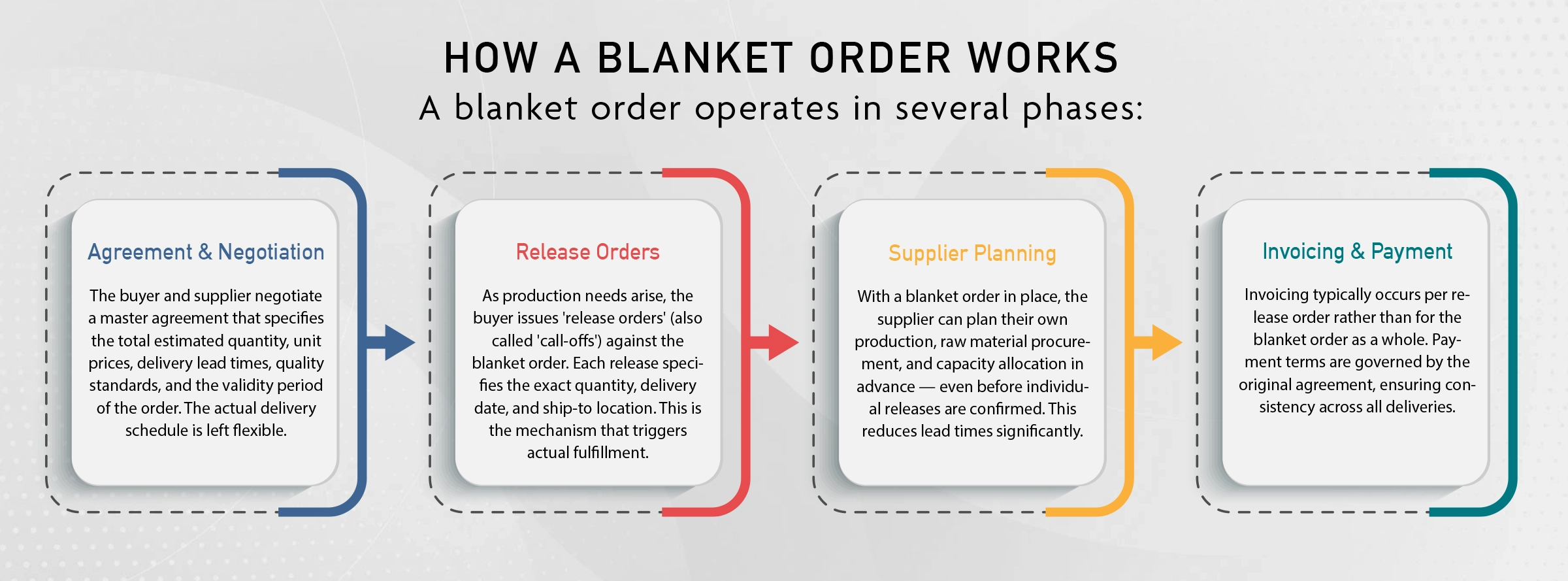
A blanket order — also known as a blanket purchase order (BPO) or standing order — is a long-term purchasing agreement between a buyer and a supplier to deliver goods or services multiple times over a set period, typically one year, at pre-negotiated prices and terms. Unlike standard purchase orders that cover a single transaction, a blanket order establishes a framework for repeated deliveries based on the buyer’s rolling demand.
In the manufacturing industry, where material requirements fluctuate with production schedules and supply chains must balance cost efficiency with agility, blanket orders have become an indispensable procurement tool.
Key Components of a Blanket Order
A well-structured blanket order typically includes the following elements:
| Component | Description | Example |
|---|---|---|
| Item Description | Specification of the goods or services | Cold-rolled steel coil, Grade CR4, 1.2mm |
| Total Estimated Quantity | Projected volume for the agreement period | 500 metric tons per year |
| Unit Price | Fixed or formula-based pricing structure | $820/MT (price locked for 12 months) |
| Validity Period | Duration of the blanket agreement | January 1, 2026 – December 31, 2026 |
| Release Window | Minimum lead time required for release | 5 business days advance notice |
| Minimum Order Quantity | Smallest quantity permitted per release | 10 MT per call-off |
| Delivery Terms | Shipping method and Incoterms | DAP – Buyer’s Facility, Chicago, IL |
| Quality Standards | Inspection requirements and criteria | ISO 9001; AQL 0.65 |
| Escalation Clauses | Conditions allowing price adjustment | Raw material index change greater than 8% |
Did You Know?
For more than forty years Mechanical Power has been supplying high-quality parts at competitive prices from around the world.
Types of Blanket Orders in Manufacturing
Fixed-Price Blanket Orders
The unit price remains constant for the entire contract period regardless of market fluctuations. This is ideal when commodity prices are stable or the buyer wants full cost predictability for budgeting purposes.
Price-Escalation Blanket Orders
Prices are tied to an index (e.g., LME metals index, PPI) and adjusted periodically. Common in raw material procurement where volatility is expected.
Quantity-Based Blanket Orders
Discounts are structured around cumulative volume. The more the buyer releases, the lower the per-unit cost — incentivizing consolidation of spend with a single supplier.
Time-Triggered Blanket Orders
Instead of quantity-based releases, deliveries occur at scheduled intervals (weekly, monthly). Common in just-in-time (JIT) environments where supply cadence must align tightly with production.
Open-Ended (Evergreen) Blanket Orders
These orders do not have a fixed end date and are renewed automatically unless cancelled. They are less common in manufacturing but are used for maintenance, repair, and operations (MRO) supplies.
How Can MPI Help You?
We can supply all of your industrial parts needs.
Click the RFQ button, email us at [email protected]
or call us at 847.487.0070 for more information.

Blanket Order vs. Standard Purchase Order
| Dimension | Blanket Order | Standard Purchase Order |
|---|---|---|
| Frequency | Multiple deliveries over time | Single transaction |
| Negotiation | Once per contract period | Every purchase |
| Pricing | Pre-agreed, often fixed | Market rate at time of order |
| Flexibility | Flexible quantities through scheduled releases | Fixed quantity per order |
| Administrative Burden | Low after initial setup | Higher due to repeated purchasing activities |
| Best For | Recurring, predictable demand | One-time or irregular purchases |
| Supplier Relationship | Long-term partnership | Transactional relationship |
| Lead Time | Shorter, as suppliers can plan inventory and production | Standard lead times or spot-buy availability |
Benefits of Blanket Orders for Manufacturers
Cost Savings
Volume discounts secured upfront without committing to large one-time deliveries
Reduced administrative costs — one negotiation, many releases
Avoidance of spot-market price spikes on critical materials
Lower inventory carrying costs through smaller, frequent deliveries
Operational Efficiency
Faster procurement cycle — release orders require minimal paperwork
Consistent supplier relationship reduces onboarding and qualification overhead
Predictable supply supports lean manufacturing and JIT production
Procurement teams freed from repetitive RFQ and negotiation cycles
Supply Chain Resilience
Supplier allocates capacity in advance, reducing stockout risk
Long-term relationship fosters supplier investment in quality and improvement
Priority treatment during supply constraints (e.g., semiconductor shortages)
Challenges and Risks
While blanket orders offer significant advantages, manufacturers must manage several risks:
Demand Forecasting Errors
Blanket orders require reasonable demand forecasts. If actual consumption deviates significantly from estimates, manufacturers may face minimum purchase obligations they cannot meet — or conversely, shortfall penalties when demand surges.
Supplier Lock-In
Multi-year blanket orders reduce flexibility to switch suppliers if better alternatives emerge. This risk is especially relevant in rapidly evolving technology components or when supplier performance deteriorates.
Price Commitment Risk
Fixed-price blanket orders can work against the buyer in a falling market, locking them into above-market rates. Conversely, suppliers may push back on long-term fixed pricing in volatile commodity environments.
Contractual Complexity
Managing dozens or hundreds of active blanket orders requires robust ERP or procurement systems. Without proper tracking, it’s easy to let agreements lapse, miss renewal windows, or exceed authorized spend limits.
Best Practices for Managing Blanket Orders
Define Clear Release Procedures
Establish a well-documented release process, including who is authorized to issue call-offs, minimum lead times, and communication channels. Ambiguity in release procedures is a leading cause of supply disruptions.
Set Realistic Quantity Estimates
Work closely with production planning to build accurate demand forecasts before committing to blanket order volumes. Build in a tolerance band (e.g., ±20%) to accommodate variability without triggering penalty clauses.
Negotiate Price Adjustment Mechanisms
Rather than purely fixed prices, consider price-escalation clauses tied to published indices. This protects both parties and makes long-term agreements more sustainable for suppliers.
Leverage ERP Integration
Modern ERP systems (SAP, Oracle, Microsoft Dynamics) have dedicated blanket order modules that automate release tracking, budget consumption monitoring, and contract expiry alerts. Full ERP integration is essential for managing blanket orders at scale.
Conduct Regular Supplier Reviews
Schedule quarterly business reviews (QBRs) to assess supplier performance against SLAs defined in the blanket order. Address quality issues, delivery performance, and cost-saving opportunities proactively.
Include Exit and Renewal Clauses
Always define termination conditions, notice periods, and automatic renewal provisions. A 30–60 day notice period for non-renewal is standard practice and prevents accidental lapses.
Industry Applications
Blanket orders are used across virtually every manufacturing sector:
| Industry | Typical Blanket Order Items | Key Benefit |
|---|---|---|
| Automotive | Steel coils, aluminum stampings, fasteners | JIT alignment and reduced stockout risk |
| Aerospace & Defense | Titanium billets, precision castings, composite materials | Long lead-time management and supply continuity |
| Electronics | PCBs, integrated circuits, passive components | Capacity reservation during component shortages |
| Consumer Goods | Packaging materials, raw chemicals, ingredients | Volume pricing and consistent supply availability |
| Heavy Equipment | Hydraulic components, castings, forgings | Improved supplier capacity planning |
| Pharmaceuticals | API raw materials, excipients, packaging materials | Regulatory continuity and supply assurance |
Conclusion
Blanket orders are one of the most powerful tools available to manufacturing procurement teams. When structured correctly, they deliver cost savings, supply continuity, and operational efficiency — creating a competitive advantage that individual spot purchases simply cannot match.
The key to success lies in balancing commitment with flexibility: negotiating strong base terms while building in mechanisms to adapt to changing demand, prices, and supplier capabilities. Paired with modern ERP systems and active supplier relationship management, blanket orders form the backbone of a resilient, cost-effective supply chain.
As global supply chains continue to face volatility — from raw material shortages to geopolitical disruptions — the ability to lock in strategic supply agreements through blanket orders will only become more valuable for manufacturers worldwide.

Daniel Szwed – Marketing Manager
Mechanical Power, Inc.