
Here’s what we’ll cover:
Why Snow Removal Equipment Is Hard on Bearings
Start With the Bearing Load and Application
Protect Bearings From Snow, Water, Salt, and Debris
Consider Corrosion-Resistant Bearing Materials
Select Lubrication for Cold Temperatures
Choose Bearing Types Based on the Specific Function
Don’t Overlook Alignment and Mounting
Design for Maintenance in Harsh Winter Conditions
Selecting Bearings for Reliable Snow Removal Equipment
FAQs
Snow removal equipment operates in conditions that are particularly hard on bearings. Snow, water, ice, road salt, abrasive debris, freezing temperatures, shock loads, and long periods of seasonal storage can all contribute to premature bearing wear or failure.
For snowplows, salt spreaders, snow blowers, and related commercial equipment, selecting a bearing based only on dimensions and load capacity can overlook some of the most important operating conditions. Sealing, corrosion resistance, lubrication, mounting, and maintenance requirements can be equally important.
OEMs and equipment manufacturers should evaluate the entire operating environment when specifying bearings for snow removal equipment. The right choice can improve reliability, reduce maintenance requirements, and help equipment remain operational when downtime is especially costly.
Why Snow Removal Equipment Is Hard on Bearings
A bearing in an indoor industrial machine may operate in a relatively controlled environment. Snow removal equipment rarely has that advantage.
Bearings used outdoors can be repeatedly exposed to moisture as snow melts around equipment. Road salt and deicing chemicals can increase the potential for corrosion. Dirt, sand, and other road debris can reach exposed components. At the same time, low ambient temperatures affect lubricant behavior, while impacts and vibration can place additional loads on the bearing.
Seasonal use creates another challenge. A machine may operate intensively during a winter storm, sit idle for days or weeks, and eventually spend months in storage. Moisture remaining inside a bearing or housing can contribute to corrosion during these idle periods.
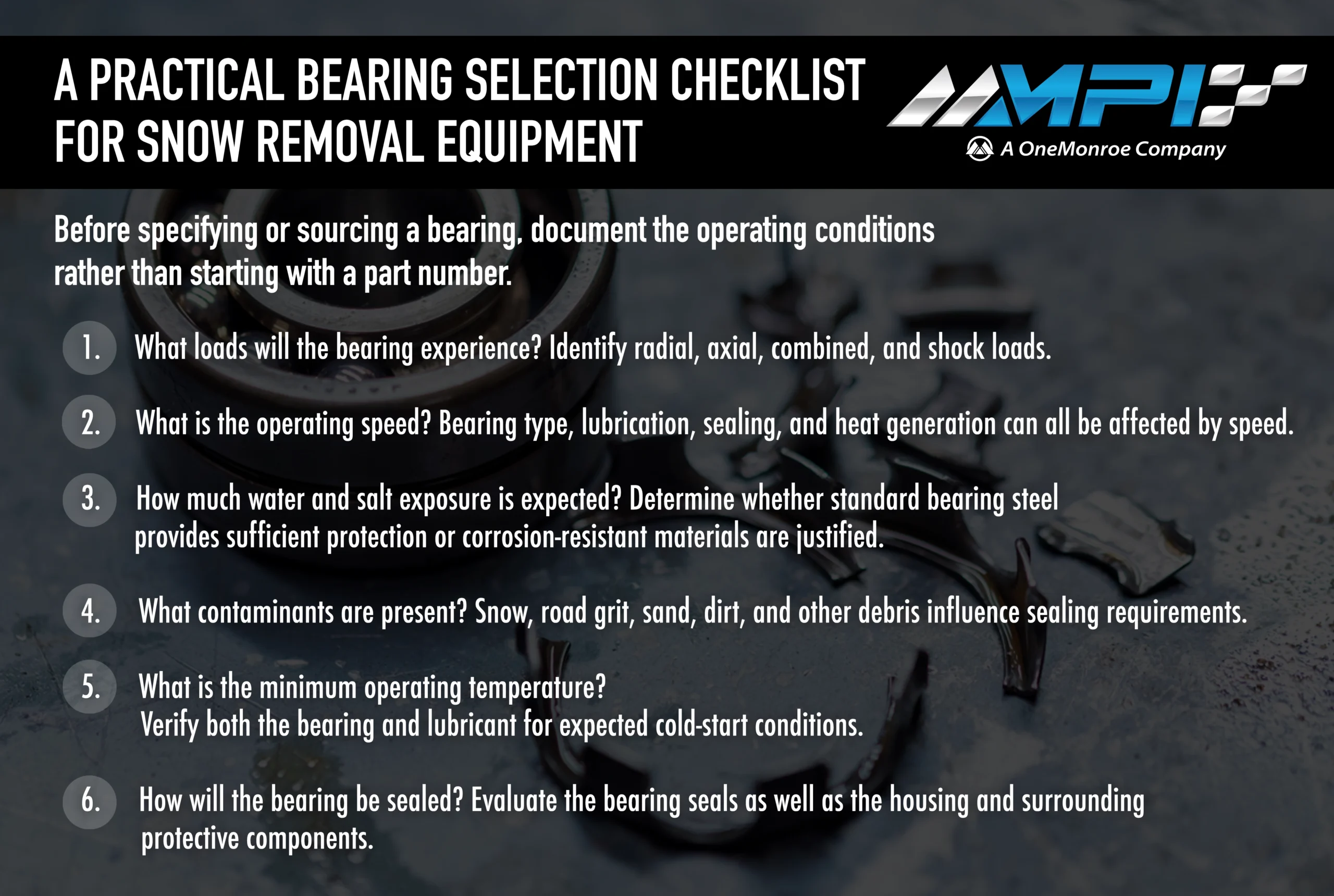
For these reasons, bearing selection for snow removal equipment should account for several conditions simultaneously:
- Radial and axial loads
- Shock and vibration
- Moisture and road-salt exposure
- Dirt and abrasive contamination
- Operating speed
- Minimum operating temperature
- Lubrication requirements
- Shaft and housing alignment
- Maintenance accessibility
- Expected equipment life and duty cycle
Ignoring any one of these factors can shorten bearing service life even if the bearing is adequately sized for the nominal load.
Start With the Bearing Load and Application
The first step is determining what the bearing must support.
Snow removal equipment includes many different rotating and oscillating assemblies, and the bearing requirements for a spreader shaft can differ substantially from those of a wheel hub, conveyor, gearbox, or other rotating component.
Radial, Axial, and Combined Loads
Radial loads act perpendicular to the shaft, while axial or thrust loads act parallel to it. Some bearing positions primarily experience one type of load, while others must support both.
Deep-groove ball bearings are commonly used for radial loads and can accommodate some axial loading. Angular contact bearings are designed for combined radial and axial loads. Roller bearing designs can be appropriate where greater radial load capacity or specific load-handling characteristics are required.
The correct bearing type depends on the actual load direction and magnitude rather than simply matching an existing bearing’s dimensions.
Account for Shock Loads
Snow removal equipment can experience loads well beyond steady-state operation. A plow can strike packed snow or an obstruction. A conveyor or spreader can encounter frozen or compacted material. Components can also be subjected to vibration while the vehicle travels over uneven surfaces.
Those conditions can produce shock loads significantly different from the equipment’s normal operating load.
Bearing selection should therefore consider maximum and transient loading, not only average operating conditions. Shaft stiffness, housing design, fits, and surrounding components should also be evaluated because bearing performance depends on the complete assembly.
Protect Bearings From Snow, Water, Salt, and Debris
Contamination control should be one of the highest priorities when specifying bearings for snow removal equipment.
Water can compromise lubrication and contribute to corrosion. Dirt and abrasive particles can damage rolling surfaces. Salt exposure makes corrosion an even greater concern.
Once contaminants enter the bearing, they can degrade the lubricant and damage rolling elements and raceways. That damage increases friction and wear and can ultimately cause premature failure.
Sealed vs. Shielded Bearings
Sealed and shielded bearings provide different levels of protection.
Metal shields can help prevent larger particles from entering a bearing while producing relatively little additional friction. They are generally better suited to environments where contamination is limited and direct water exposure is unlikely.
Contact seals provide a stronger barrier against dirt and moisture. For exposed snow removal applications, that additional protection can make them preferable even though contact seals may produce more friction than shields.
The bearing seal is only part of the system. Housing seals, flingers, covers, and other external barriers may be necessary in particularly wet or contaminated locations.
For severe applications, using multiple barriers between the environment and the rolling elements can provide better protection than relying on a single bearing seal.
Consider Corrosion-Resistant Bearing Materials
Standard bearing steel offers excellent hardness, fatigue resistance, and load-carrying capability, but corrosion can become a concern when it is repeatedly exposed to moisture and salt.
For that reason, material selection deserves special attention in snow removal applications.
Carbon Steel Bearings
High-carbon chromium bearing steel, including 52100 steel, is widely used because of its hardness, strength, fatigue resistance, availability, and cost effectiveness.
A properly sealed and lubricated carbon steel bearing can perform well in many outdoor applications. It should not automatically be eliminated simply because equipment operates outdoors.
The key question is how much moisture and corrosive material will actually reach the bearing.
If the bearing is well protected inside an effective housing and sealing system, carbon steel may provide an economical solution. If it is routinely exposed to water, road salt, or deicing chemicals, additional corrosion protection may be warranted.
Stainless Steel Bearings
Stainless steel bearings are an option where corrosion resistance is a higher priority.
For example, 440C stainless steel is commonly used for bearing components because it combines corrosion resistance with the hardness required for many bearing applications.
Stainless steel, however, should not be treated as an automatic upgrade for every snow removal application. Depending on the bearing design and material, stainless options can have different load ratings and cost more than comparable carbon steel bearings.
The decision should balance corrosion exposure, required load capacity, maintenance requirements, expected service life, and total cost.
For a more detailed material comparison, see MPI’s guide to stainless steel vs. carbon steel bearings for outdoor applications.
Coatings and Corrosion-Resistant Housings
The choice is not limited to standard carbon steel versus stainless steel.
Depending on the application, manufacturers may also consider coated bearing components, corrosion-resistant housings, stainless steel housings, plated housings, or other protective treatments.
A hybrid approach can sometimes provide the required environmental protection without the cost of manufacturing every bearing component from stainless steel.
Need bearings or other components for snow removal equipment?
Mechanical Power works with OEMs and equipment manufacturers to source standard and custom bearings along with power transmission and engineered components for demanding outdoor applications.

Select Lubrication for Cold Temperatures
The correct bearing can still fail prematurely if its lubricant is poorly suited to winter operation.
Grease becomes more viscous as temperature decreases. At sufficiently low temperatures, an inappropriate lubricant can create high starting torque and may not release enough base oil to properly lubricate the rolling contacts.
This is particularly relevant for snow removal equipment that may sit outdoors for hours before being started in freezing conditions.
Evaluate the Grease’s Low-Temperature Performance
Do not assume that a general-purpose grease is suitable simply because the bearing itself has an acceptable temperature rating.
Grease selection should consider:
- Minimum startup temperature
- Bearing speed
- Load
- Base oil viscosity
- Grease consistency
- Water resistance
- Corrosion protection
- Compatibility with seals
- Relubrication requirements
Equipment that operates intermittently at very low temperatures can require different lubrication characteristics from machinery that runs continuously and generates enough heat to raise bearing temperature.
The lubricant manufacturer’s specified operating range should always be checked against the application’s actual winter conditions.
Moisture Changes the Lubrication Strategy
Lubrication does more than reduce friction. In contaminated applications, grease can also help form part of the barrier protecting a bearing.
If water or contaminants are entering a bearing arrangement, more frequent relubrication may be necessary to remove contaminated grease and replenish protection. In severe applications, the lubrication and sealing strategy should be designed together rather than treated as separate decisions.
Avoid assuming that adding more grease is always better. Excess grease can create churning, increased operating temperature, and other problems. Grease quantity and relubrication intervals should follow the bearing and equipment manufacturer’s recommendations.
Choose Bearing Types Based on the Specific Function
There is no single “snow removal bearing.” Different assemblies within the same piece of equipment may require different bearing designs.
Ball Bearings
Ball bearings are widely used where relatively low friction, moderate loads, and higher rotational speeds are required.
Deep-groove ball bearings can support radial loads along with limited axial loads, making them useful across a broad range of rotating equipment.
For snow removal applications, sealed versions and corrosion-resistant materials may be appropriate where exposure is a concern.
Mounted and Pillow Block Bearings
Mounted bearing units combine a bearing and housing into an assembly that can simplify installation and replacement.
These units can be useful on shafts, conveyors, spreaders, and other equipment where the bearing must be attached directly to a machine structure. Depending on the application, mounted units are available with different housing materials, bearing inserts, locking methods, seals, and relubrication options.
Corrosion-resistant inserts and housings can be especially useful where a mounted unit is exposed to snow, slush, salt, and road spray.
Roller Bearings
Roller bearings use rolling elements with a larger contact area than balls and can provide greater load capacity in suitable applications.
Tapered roller bearings, for example, can support both radial and axial loading. Spherical roller bearings can support heavy radial loads and accommodate some misalignment.
The appropriate roller bearing depends on load direction, speed, alignment, space, and other application-specific requirements.
Insert Bearings
Insert bearings are commonly incorporated into mounted bearing units and can simplify shaft attachment through set screws, eccentric locking collars, or other locking methods.
They are available with different seals and materials, including corrosion-resistant configurations. For exposed snow removal machinery, those options allow manufacturers to tailor the bearing and housing combination to the environment rather than relying on a standard indoor-duty unit.
MPI supplies a broad selection of custom and standard industrial bearings, including ball bearings, tapered roller bearings, spherical roller bearings, insert bearings, pillow block bearings, mounted units, wheel hub bearings, and other bearing types.
Don’t Overlook Alignment and Mounting
Even a correctly specified bearing can experience a shortened service life if it is installed incorrectly.
Misalignment can place unintended loads on rolling elements and raceways. Improper shaft or housing fits can lead to creep, excessive internal clearance, insufficient clearance, or other operating problems. Incorrect locking methods can also allow movement between the bearing and shaft.
Equipment designers should evaluate:
- Shaft diameter and tolerances
- Housing tolerances
- Shaft deflection
- Alignment
- Bearing internal clearance
- Locking method
- Installation procedure
- Thermal expansion
Where some misalignment is unavoidable, a self-aligning bearing or mounted bearing configuration may be appropriate.
The goal is not simply to find a bearing that fits the available space. The bearing, shaft, housing, seals, lubricant, and mounting arrangement need to function as a complete system.
Design for Maintenance in Harsh Winter Conditions
Bearing selection should also reflect how the equipment will actually be maintained.
A bearing that requires frequent lubrication may be a reasonable choice if grease fittings are easy to access. The same design can become problematic if technicians must remove guards or other components every time the bearing needs service.
OEMs should consider maintenance access during equipment design, including the location of grease fittings and whether bearings can be inspected or replaced without extensive disassembly.
Maintenance procedures should also include regular checks for:
- Damaged or displaced seals
- Corrosion around housings and shafts
- Water contamination in grease
- Unusual noise or vibration
- Excessive bearing play
- Loose mounting hardware
- Lubricant leakage
Catching these conditions early can prevent a relatively inexpensive bearing issue from damaging shafts, housings, sprockets, or other components.
Plan for Seasonal Storage
Winter operation receives most of the attention, but storage conditions can also affect bearing life.
Snow removal equipment may sit unused throughout spring, summer, and fall. If moisture, road salt, or contaminated grease remains around bearings when equipment is parked, corrosion can continue during storage.
Before seasonal storage, operators should follow the equipment manufacturer’s maintenance procedures, which may include cleaning salt and debris from the machine, inspecting seals and housings, lubricating specified points, and replacing damaged components.
For OEMs, storage conditions should be considered during bearing and seal selection. Equipment expected to spend much of its life outdoors may need stronger corrosion protection than equipment stored in a dry, climate-controlled facility.
Selecting Bearings for Reliable Snow Removal Equipment
Snow removal machinery demands more from bearings than basic load capacity. Bearings may need to perform through freezing temperatures, road salt, moisture, contamination, vibration, shock loads, and months of seasonal storage.
Effective bearing selection therefore requires a system-level approach. Load capacity and speed remain important, but so do sealing, lubrication, material selection, mounting, corrosion resistance, and maintenance access.
Mechanical Power supports OEMs and equipment manufacturers with snow removal equipment components and a wide range of custom and standard bearings. MPI can help source bearing configurations based on application requirements while also supporting related components used throughout snow removal equipment.
For manufacturers evaluating a new bearing application, replacement component, or sourcing program, defining the operating environment early can help identify a solution that balances reliability, availability, and total cost.
FAQs
What bearings are best for snow removal equipment?
There is no single bearing type that is best for every snow removal application. Selection depends on load, speed, shaft arrangement, contamination, moisture exposure, operating temperature, and maintenance requirements. Sealed ball bearings, mounted units, insert bearings, and several roller bearing designs may all be appropriate depending on the equipment.
Should snow removal equipment use stainless steel bearings?
Stainless steel bearings can be beneficial where moisture, road salt, or other corrosive materials regularly reach the bearing. However, properly sealed carbon steel bearings may be a more cost-effective solution in protected locations. Load requirements, corrosion exposure, sealing, maintenance, and lifecycle cost should all be evaluated before specifying stainless steel.
Are sealed bearings better for snow removal equipment?
Sealed bearings are often preferable in locations exposed to snow, water, dirt, and road spray because seals provide greater contamination protection than shields. The complete sealing arrangement should still be evaluated because an integral bearing seal may not provide sufficient protection in severe environments.
Does cold weather affect bearing grease?
Yes. Grease becomes more viscous at low temperatures, which can increase starting torque and affect lubricant delivery to rolling contacts. Bearings used in winter equipment should have grease suitable for the application’s minimum startup temperature, speed, load, and environmental conditions.
How does road salt affect bearings?
Road salt can accelerate corrosion when salt-contaminated moisture reaches susceptible bearing surfaces and surrounding components. Effective seals, corrosion-resistant materials or coatings, suitable lubrication, and proper cleaning and maintenance can help reduce the risk.

Mechanical Power, Inc.