
When OEMs and equipment manufacturers evaluate global suppliers for industrial components such as hydraulic cylinders, machined parts, castings, bearings, or fabricated assemblies, the quoted price rarely tells the whole story. Freight surcharges, customs delays, failed inspections, excess inventory, and currency fluctuations can quietly reduce — or even erase — the savings that made an offshore supplier attractive in the first place.
The better comparison is not simply unit price. It is total landed cost.
A more complete sourcing equation looks like this:
Unit Price + Freight + Duties + Quality Costs + Inventory Costs + Supply Risk = True Sourcing Cost
Understanding where these hidden costs come from — and how to structure sourcing relationships to control them — can mean the difference between a sourcing decision that creates long-term value and one that creates unexpected cost and disruption later.
1. Quality and Rework Costs
A supplier quote that looks 15% cheaper than a domestic alternative can stop looking inexpensive very quickly when a shipment fails dimensional, material, or performance requirements.
Out-of-spec parts can create costs throughout the operation, including rework, scrap, additional inspections, replacement shipments, production delays, warranty claims, and customer downtime.
The risk becomes even more significant when defects are not discovered until components have already been installed in finished equipment.
For products such as hydraulic cylinders, machined components, castings, and fabricated assemblies, supplier quality systems should be evaluated as carefully as price.
How to Reduce Quality Risk
Work with suppliers that maintain documented quality systems and, where appropriate, recognized certifications such as ISO 9001.
Procurement teams should also consider:
- Requiring pre-shipment inspections before goods leave the supplier
- Requesting inspection reports, photos, or video documentation
- Defining dimensional and material requirements clearly on drawings and purchase orders
- Establishing inspection criteria and acceptance limits before production begins
- Tracking supplier performance across multiple orders
Supplier qualification should happen before the first production shipment — not after a quality issue appears.
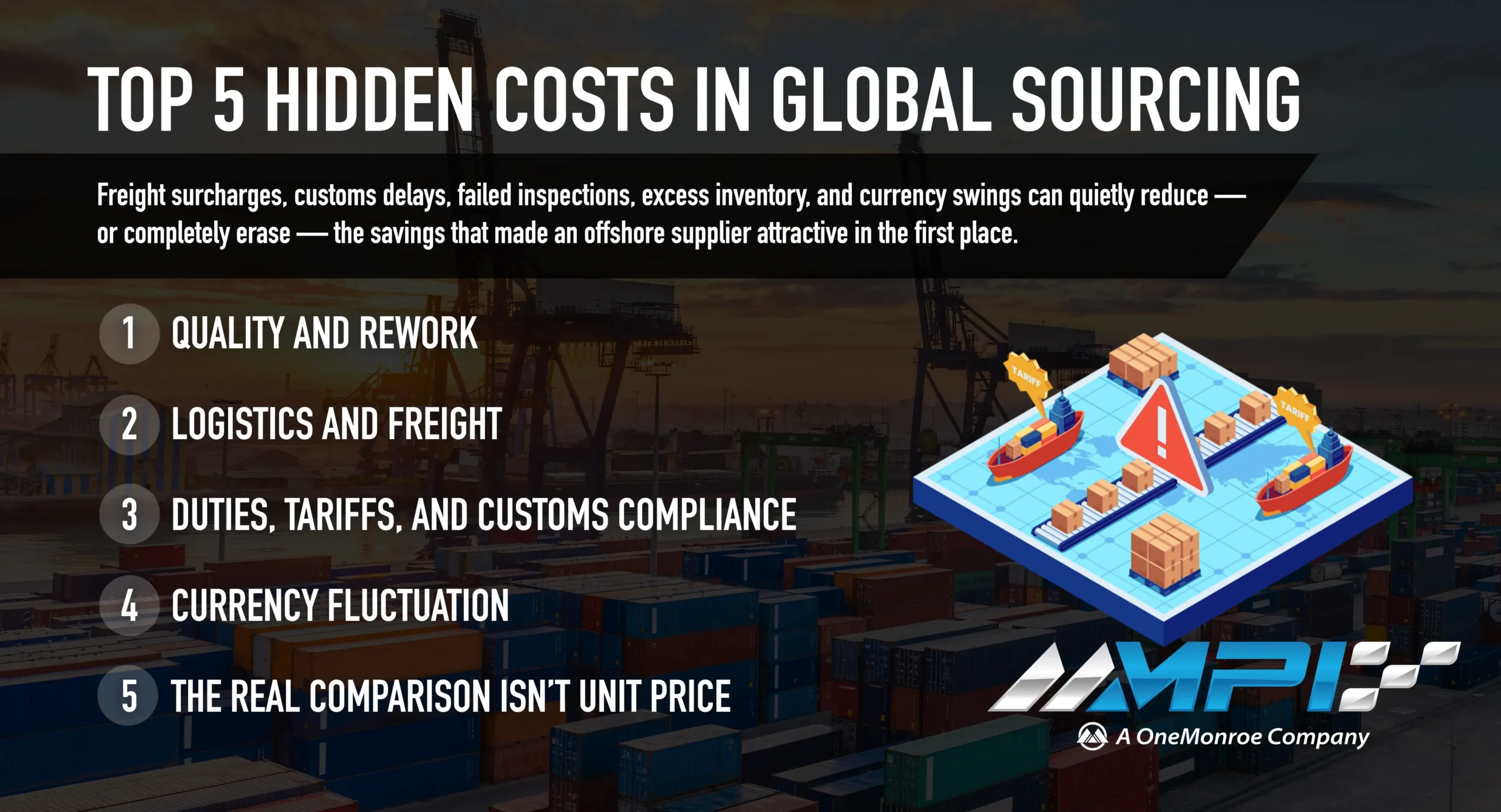
2. Logistics and Freight Volatility
One of the most common mistakes in global sourcing is comparing supplier quotes without accounting for the complete transportation cost.
FOB pricing may cover getting the product to an agreed origin point, but it does not represent what that product will ultimately cost once it reaches your facility.
Additional logistics costs may include:
- Ocean freight
- Fuel surcharges
- Port handling
- Drayage
- Customs brokerage
- Inland transportation
- Container fees
- Storage
- Demurrage
- Expedited freight
Transportation costs can also change between the time a supplier provides a quote and the time the shipment actually moves.
When ocean freight becomes constrained or production slips, buyers may be forced to use expedited air freight to avoid a customer shutdown or missed production schedule. One emergency shipment can quickly eliminate months of expected sourcing savings.
How to Reduce Freight Risk
Procurement teams should build freight assumptions directly into landed-cost calculations rather than comparing suppliers on FOB price alone.
Other strategies include:
- Negotiating freight agreements where purchasing volume supports it
- Consolidating shipments where practical
- Planning replenishment well ahead of production requirements
- Maintaining domestic or nearshore alternatives for critical components
- Evaluating logistics performance as part of supplier selection
The goal is not simply lower transportation cost. The goal is greater predictability.
3. Duties, Tariffs, and Customs Compliance
Duties and tariffs can significantly affect the actual cost of imported industrial components.
The amount owed can depend on several factors, including:
- HTS classification
- Country of origin
- Product material
- Applicable tariff programs
- Trade remedies
- Current import regulations
Incorrect classification or incomplete documentation can also create customs delays, additional brokerage costs, storage fees, or demurrage.
These expenses are often overlooked when procurement teams compare a domestic quote directly against an overseas supplier’s unit price.
How to Reduce Customs and Tariff Risk
Before placing a significant international order, buyers should understand how the product will be classified and what duties may apply.
Good practices include:
- Working with an experienced customs broker
- Confirming HTS classifications before finalizing the sourcing decision
- Monitoring changes to tariff schedules and trade regulations
- Maintaining accurate country-of-origin documentation
- Including applicable duties in the landed-cost calculation
A supplier that appears inexpensive before customs clearance may look very different once all import costs are included.
Build a More Predictable Global Sourcing Strategy
The lowest quote does not always create the lowest cost.
4. Currency Fluctuation
Currency exposure is another sourcing cost that can be easy to overlook.
When suppliers quote in RMB, EUR, or another foreign currency, the exchange rate at the time of quotation may not be the same rate when invoices are paid months later.
Even relatively small exchange-rate movements can affect margins on large or recurring purchasing programs.
Currency exposure becomes especially important when companies negotiate long-term agreements or blanket purchase orders covering several months of production.
How to Reduce Currency Risk
Depending on the purchasing arrangement, procurement teams may be able to reduce currency exposure by:
- Negotiating pricing in U.S. dollars
- Establishing fixed-price periods
- Using forward contracts for larger purchasing commitments
- Reviewing currency exposure during long-term negotiations
- Building reasonable exchange-rate assumptions into product costing
The objective is not necessarily to predict currency movements. It is to reduce how much those movements can unexpectedly affect program economics.
5. Lead Time and Inventory Carrying Costs
Longer global supply chains usually require more inventory.
If a domestic supplier can replenish components in a few weeks but an international supplier requires several months between production and delivery, procurement teams often need additional safety stock to protect production.
That inventory creates its own cost.
Working capital is tied up in components sitting on shelves. Warehouse space is required. Inventory must be tracked, handled, insured, and managed. There is also the risk that demand changes before the inventory is consumed.
When actual demand exceeds the forecast, long replenishment cycles can create another costly problem: expedited freight.
How to Reduce Lead-Time and Inventory Costs
One of the most effective strategies is using blanket purchase orders with scheduled releases.
Rather than receiving an entire annual requirement at once, buyers can commit to larger purchasing volumes while receiving inventory on an agreed schedule.
This can help:
- Lock in pricing
- Improve supplier production planning
- Create predictable replenishment
- Reduce warehouse requirements
- Lower working capital tied up in inventory
- Provide more flexibility when demand changes
The strongest sourcing relationships also allow release timing to adjust as actual demand evolves.
This is where sourcing strategy and inventory management begin working together.
Need to reduce sourcing risk or identify alternative suppliers?
Talk with Mechanical Power about your sourcing requirements and learn how a more predictable global sourcing strategy can help control cost, quality, inventory, and lead-time risk.

The Real Comparison Isn’t Unit Price — It’s Total Landed Cost
Global sourcing can still create significant cost advantages for OEMs and industrial companies.
But those savings should be evaluated using the complete cost of getting the component into production.
That means looking beyond the quoted price and considering:
Purchase Price + Freight + Duties + Quality Risk + Inventory Carrying Cost + Lead-Time Risk
A supplier offering the lowest unit price may not necessarily provide the lowest overall cost.
In many cases, a slightly higher component price combined with better quality control, more predictable logistics, flexible inventory programs, and consistent delivery can create a better sourcing outcome.
At Mechanical Power, our global sourcing approach is built around more than simply identifying overseas suppliers. We help OEMs and industrial customers evaluate supplier capabilities, quality requirements, logistics, inventory strategy, and purchasing structures to create a more predictable supply chain.
For hydraulic cylinders and other engineered industrial components, that broader sourcing strategy can help reduce the hidden costs that often appear after the purchase order is issued.
FAQs
What are the most common hidden costs of global sourcing?
What is total landed cost?
Why is FOB price not the same as total sourcing cost?
How can OEMs reduce quality risks when sourcing internationally?
How do tariffs affect global sourcing?

Mechanical Power, Inc.