
Here’s what we’ll cover:
- Incorrect Fastener Material Selection
- Improper Torque During Installation
- Joint Design That Doesn’t Distribute Load Properly
- Vibration-Induced Loosening
- Corrosion and Environmental Exposure
- Fatigue from Repeated Cyclic Loading
- Thread Damage and Poor Assembly Practices
- How to Prevent Industrial Fastener Failures
- Frequently Asked Questions
- Conclusion
Why Fasteners Fail
Industrial fasteners are designed to withstand demanding operating conditions, but even the highest-quality hardware can fail if it is improperly selected, installed, or maintained. In many cases, the fastener itself is not defective. Instead, the surrounding joint design, environmental conditions, or installation process creates conditions that eventually lead to failure.
Below are seven of the most common—and often overlooked—causes of industrial fastener failures.
1. Incorrect Fastener Material Selection
Selecting a fastener based only on strength can lead to premature failure.
Different industrial applications require different material characteristics, including corrosion resistance, ductility, fatigue strength, and temperature resistance. For example, a carbon steel bolt used in a corrosive environment may deteriorate rapidly, while a stainless steel fastener may not provide sufficient strength for a heavy structural application.
When selecting fasteners, engineers should evaluate:
- Operating environment
- Exposure to chemicals or moisture
- Temperature range
- Mechanical loading
- Expected service life
2. Improper Torque During Installation
Both over-tightening and under-tightening create reliability problems.
Excessive torque can permanently stretch a bolt beyond its elastic limit, weakening the fastener and reducing fatigue life. Under-tightening leaves insufficient clamping force, allowing movement between joint components that eventually leads to loosening and failure.
Because friction affects torque readings, installation should always follow manufacturer specifications using calibrated torque tools.
3. Joint Design That Doesn’t Distribute Load Properly
Even premium fasteners cannot compensate for poor joint design.
Misaligned components, uneven bearing surfaces, flexible joint members, or poor fastener spacing concentrate stress in localized areas. Over time, these stress concentrations lead to fatigue cracks, thread damage, or joint separation.
A properly engineered joint distributes loads evenly across every fastener while minimizing bending forces.
4. Vibration-Induced Loosening
Equipment exposed to continuous vibration is especially susceptible to fastener loosening.
Motors, pumps, compressors, conveyors, heavy equipment, and rotating machinery all generate cyclic forces that gradually reduce clamp load. Once preload decreases, small joint movements accelerate loosening and eventually damage surrounding components.
Common solutions include:
- Prevailing torque locknuts
- Thread-locking compounds
- Wedge-lock washers
- Safety wire
- Proper preload calculations
5. Corrosion and Environmental Exposure
Corrosion gradually weakens both the fastener and the joint.
Industrial environments often expose fasteners to moisture, road salt, chemicals, process fluids, and temperature extremes. Corrosion pits become stress concentrators that significantly reduce fatigue strength.
Engineers should consider corrosion-resistant materials and protective coatings whenever equipment operates in harsh environments.
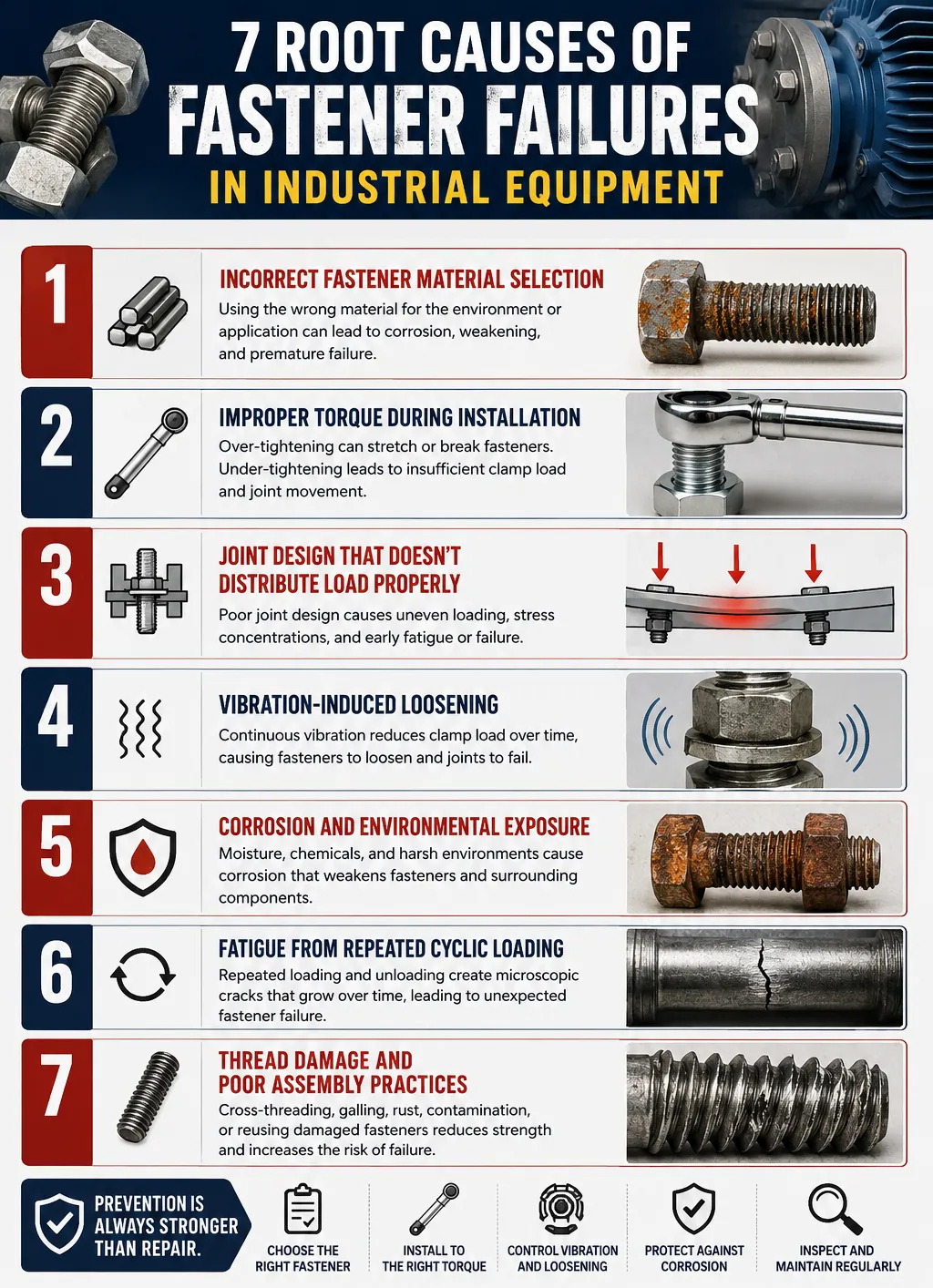
6. Fatigue from Repeated Cyclic Loading
Many fasteners fail without ever reaching their published tensile strength.
Repeated loading and unloading initiate microscopic cracks that slowly grow with every operating cycle until the fastener fractures unexpectedly.
Common fatigue contributors include:
- Machinery vibration
- Thermal expansion
- Repeated loading cycles
- Shock loading
- Improper preload
Designing for fatigue requires accurate load calculations, proper preload, and minimizing stress concentrations.
7. Thread Damage and Poor Assembly Practices
Thread damage is one of the most overlooked causes of fastener failure.
Cross-threading, galling, rust, contamination, reused damaged fasteners, or insufficient thread engagement all reduce joint strength and reliability.
Technicians should inspect hardware before installation and replace fasteners that show signs of wear, deformation, or corrosion.
How to Prevent Industrial Fastener Failures
Preventing fastener failures requires more than simply selecting a stronger bolt. Successful fastening systems combine proper engineering, quality hardware, correct installation techniques, and routine preventive maintenance.
Following these best practices can significantly improve equipment reliability:
- Select fasteners for the actual operating environment.
- Follow manufacturer torque specifications.
- Use calibrated installation tools.
- Inspect fasteners during preventive maintenance.
- Replace damaged or corroded hardware.
- Use vibration-resistant fastening methods where appropriate.
- Review joint design during equipment development.
Even small improvements in fastening practices can dramatically reduce downtime and maintenance costs.
Frequently Asked Questions
What causes fastener loosening under vibration?
How can engineers prevent fastener fatigue failures?
Should industrial fasteners always be reused?
Does using a stronger bolt always improve reliability?
Conclusion
Industrial fastener failures are rarely caused by defective hardware alone. More often, failures result from overlooked design details, improper installation, environmental exposure, or inadequate maintenance practices. Understanding these seven common industrial fastener failure causes allows engineers to improve equipment uptime, extend component life, and reduce costly repairs.
Investing in proper fastener selection, joint design, and preventive maintenance today helps avoid expensive equipment failures tomorrow.
How Can MPI Help You?
We can supply all of your fastener needs.
Click the RFQ button, email us at [email protected]
or call us at 847.487.0070 for more information.
Tell us what you need and we will save you time and money.


Daniel Szwed – Marketing Manager
Mechanical Power, Inc.