
Here’s what we’ll cover:
What hydraulic cylinder sizing actually involves
Step 1: Calculate the required force
Step 2: Determine stroke length
Step 3: Choose cylinder type
Step 4: Confirm mounting style and rod end
What to have ready when you contact MPI
When standard sizing doesn’t fit
Frequently asked questions
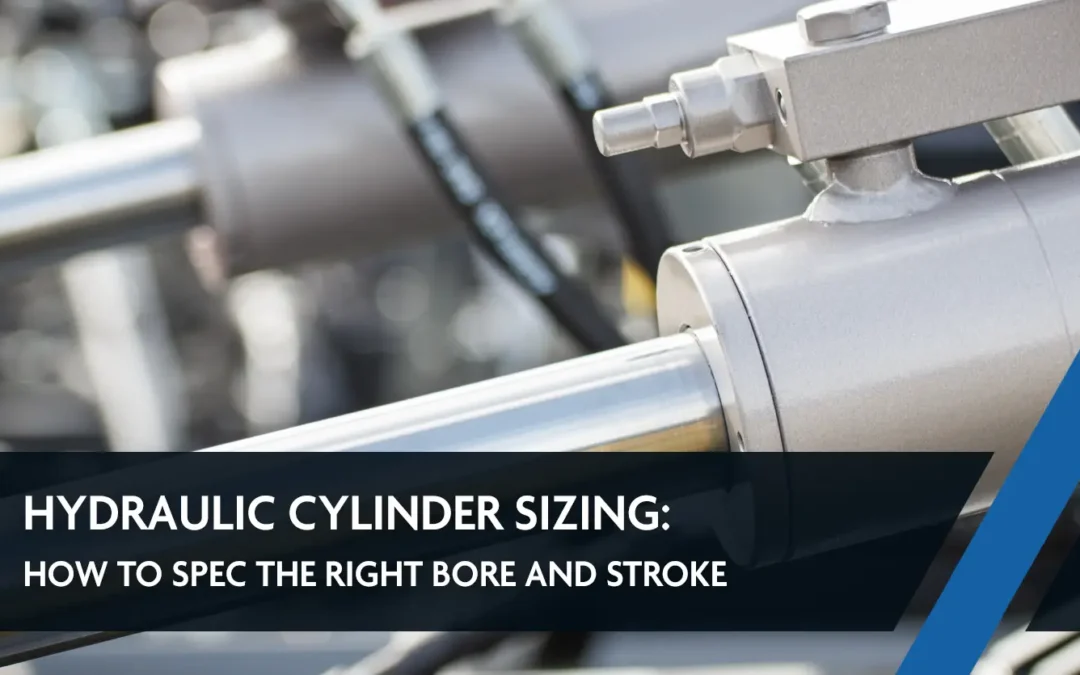
This guide explains how to size a hydraulic cylinder correctly, what information you need before placing an order, and where custom or non-standard specs require closer supplier collaboration.
What hydraulic cylinder sizing actually involves
Sizing a hydraulic cylinder means determining two primary dimensions:
• Bore diameter — the inside diameter of the cylinder barrel, which determines force output.
• Stroke length — the distance the piston rod travels, which determines how far the load moves.
Both dimensions are driven by your application requirements, not by catalog availability. The right starting point is always the load, not the part.
Step 1: Calculate the required force
The force a hydraulic cylinder produces depends on system pressure and bore area. The formula is:
Force (lbf) = Pressure (psi) × Bore Area (in²) Bore Area = π × (Bore Diameter ÷ 2)²
Most industrial hydraulic systems operate between 1,500 and 3,000 psi. If your system pressure is fixed, work backward from the required force to determine the minimum bore diameter.
Worked example: You need 15,000 lbf of push force. Your system runs at 2,500 psi. Required bore area = 15,000 ÷ 2,500 = 6.0 in². That gives a bore diameter of approximately 2.76 inches — so you would specify a 3-inch bore as the next standard size up.
Step 2: Determine stroke length
Stroke length is the total distance the piston rod needs to travel to complete the intended motion. Measure the full range of movement required in the application, then add a small margin — typically 0.5 to 1 inch — to account for mechanical tolerances and mounting variation.
Key considerations when specifying stroke:
• Longer strokes increase the risk of rod buckling under compressive load. For strokes above 40 inches, a buckling analysis is strongly recommended.
• Extended stroke cylinders may require intermediate support or a larger rod diameter to maintain rigidity.
• Retracted length (closed length) affects how the cylinder mounts into your assembly. Confirm the retracted envelope fits within your design space before finalizing stroke.
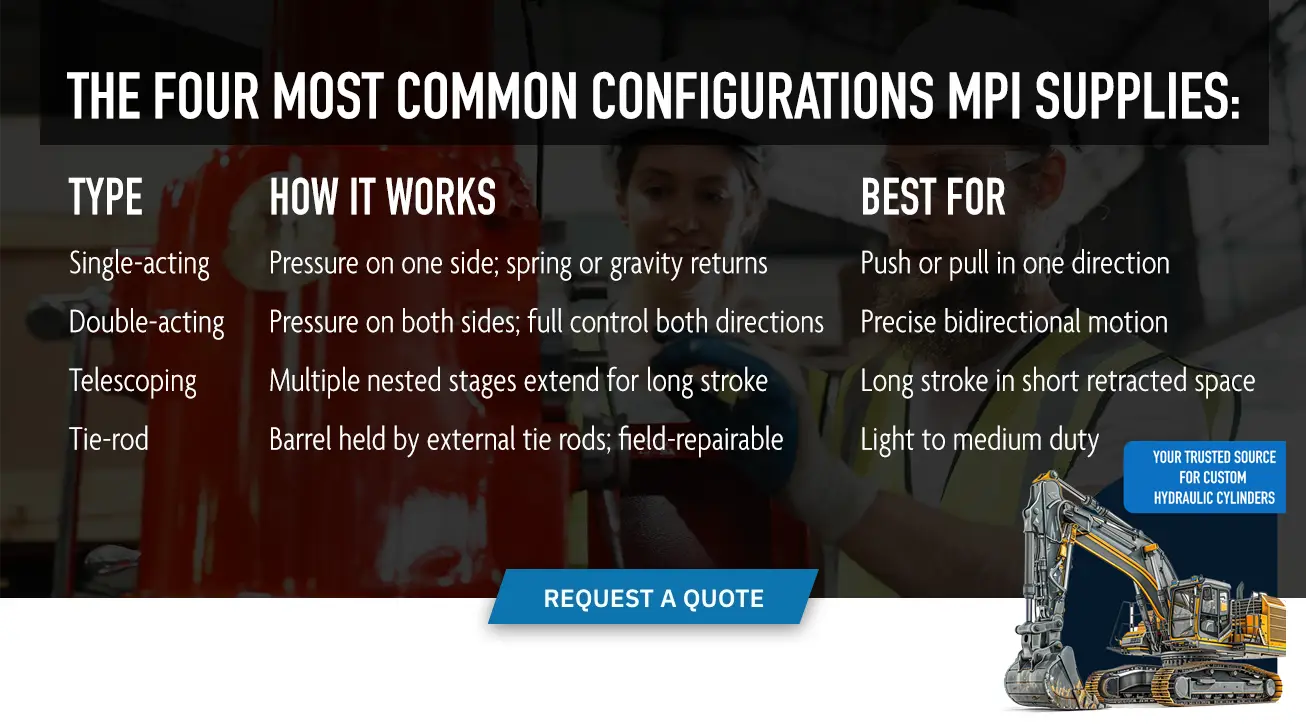
Step 3: Choose cylinder type
Bore and stroke define the size. Cylinder type defines how it operates.
Step 4: Confirm mounting style and rod end
A correctly sized cylinder that is incorrectly mounted will fail prematurely. Mounting style determines how the cylinder absorbs side load and attaches to the machine frame. Common options include:
Clevis mount
pin-connected, allows angular movement, common in mobile equipment.
Flange mount
bolted directly to a plate or frame, high rigidity, fixed alignment required.
Trunnion mount
pivot point along the cylinder body, used where the load swings through an arc.
Foot mount
bolted at the cap end, simple, suited for in-line push applications.
Rod end style
threaded, clevis, or eye — should match the attachment point on the machine. Specifying the wrong rod end adds lead time and cost.
What to have ready when you contact MPI
The more complete your specification, the faster MPI can source or manufacture the right cylinder.
At minimum, have the following before requesting a quote:
1. Required force output (lbs) or the load weight and coefficient of friction
2. System operating pressure (psi)
3. Required stroke length (inches)
4. Cylinder type — single-acting, double-acting, telescoping, or tie-rod
5. Mounting style and rod end configuration
6. Operating environment — temperature range, exposure to moisture, chemicals, or abrasives
7. Duty cycle — continuous, intermittent, or shock loading
If you have an existing cylinder to match or replace, a drawing or the OEM part number speeds the process significantly.
When standard sizing doesn’t fit
Not every application fits a catalog size. Custom bore diameters, non-standard strokes, specialty seal materials for extreme temperatures, and corrosion-resistant coatings are all available through MPI’s manufacturing network. If your spec falls outside standard ranges, MPI’s sourcing team can work directly with domestic and international manufacturing partners to produce a purpose-built cylinder to your drawing.
MPI has supplied custom hydraulic cylinders for snow removal equipment, agricultural machinery, material handling systems, and OEM production lines across the Midwest and nationally.
Source hydraulic cylinders through MPI
MPI has supplied custom and standard hydraulic cylinders to OEMs, equipment manufacturers, and industrial operations for over 40 years. Whether you are replacing an existing cylinder or specifying a new application, MPI’s sourcing team can help you identify the right configuration and deliver it on schedule.
Maximize efficiency of your equipment.
Frequently asked questions
How do I calculate hydraulic cylinder bore size?
What is a standard hydraulic cylinder stroke length?
What is the difference between tie-rod and welded hydraulic cylinders?
How do I know if I need a single-acting or double-acting cylinder?
How do sourcing companies help improve supply chain resilience?
Through supplier diversification, domestic and offshore hybrid sourcing, inventory programs, and long-term procurement partnerships.
Can MPI source hydraulic cylinders to a custom spec?
How Can MPI Help You?
We can supply all of your Hydraulic Cylinder needs.
Click the RFQ button, email us at [email protected]
or call us at 847.487.0070 for more information.
Tell us what you need and we will save you time and money.


Daniel Szwed – Marketing Manager
Mechanical Power, Inc.