
Here’s what we’ll cover:
Why IMTS 2026 signals a shift in industrial AI
Where AI can support procurement and supplier management
How AI can improve forecasting and inventory decisions
How sourcing teams can use AI to evaluate RFQs and supplier information
Frequently Asked Questions
Why manufacturing expertise and supplier relationships still matter
How manufacturers should evaluate AI opportunities based on ROI
Artificial intelligence in manufacturing is moving into a more practical phase.
The question is becoming less about what AI could eventually do and more about where it can improve uptime, quality, cost, throughput, and decision-making today.
IMTS 2026 provided a strong example of that shift. For the first time, the International Manufacturing Technology Show featured a dedicated Industrial AI Conference and Industrial AI Arena. The conference focused on practical factory-floor implementation, including identifying high-value opportunities, assessing data readiness, predictive maintenance, quality applications, and edge-versus-cloud decisions.
Most importantly, the conversation centered on measurable manufacturing results.
That matters beyond the factory floor. For procurement and supply-chain teams, the same shift is happening. AI can help analyze more supplier, inventory, quality, forecasting, and sourcing information than purchasing teams could reasonably evaluate manually.
The opportunity is not to automate every sourcing decision. It is to use AI to help people make better ones.
IMTS 2026 Put Industrial AI on the Factory Floor
IMTS is one of the largest manufacturing technology events in the world, and more than 90,000 people registered for the September 14–19, 2026 show in Chicago.
This year, industrial AI received dedicated attention for the first time.
The new Industrial AI Arena showcased applied technologies addressing quality and inspection, process optimization, downtime reduction, cybersecurity, safety, and demand forecasting. The Industrial AI Conference focused specifically on moving from experimentation toward implementation.
Attendees were encouraged to identify high-value opportunities, determine whether their data was ready, distinguish quick-return projects from longer-term capability building, and evaluate results using actual manufacturing metrics.
That approach is important.
Manufacturers do not need AI because AI is the latest technology trend. They need technologies that solve expensive problems.
The same standard should apply to procurement.
Where Can AI Create Value in Procurement?
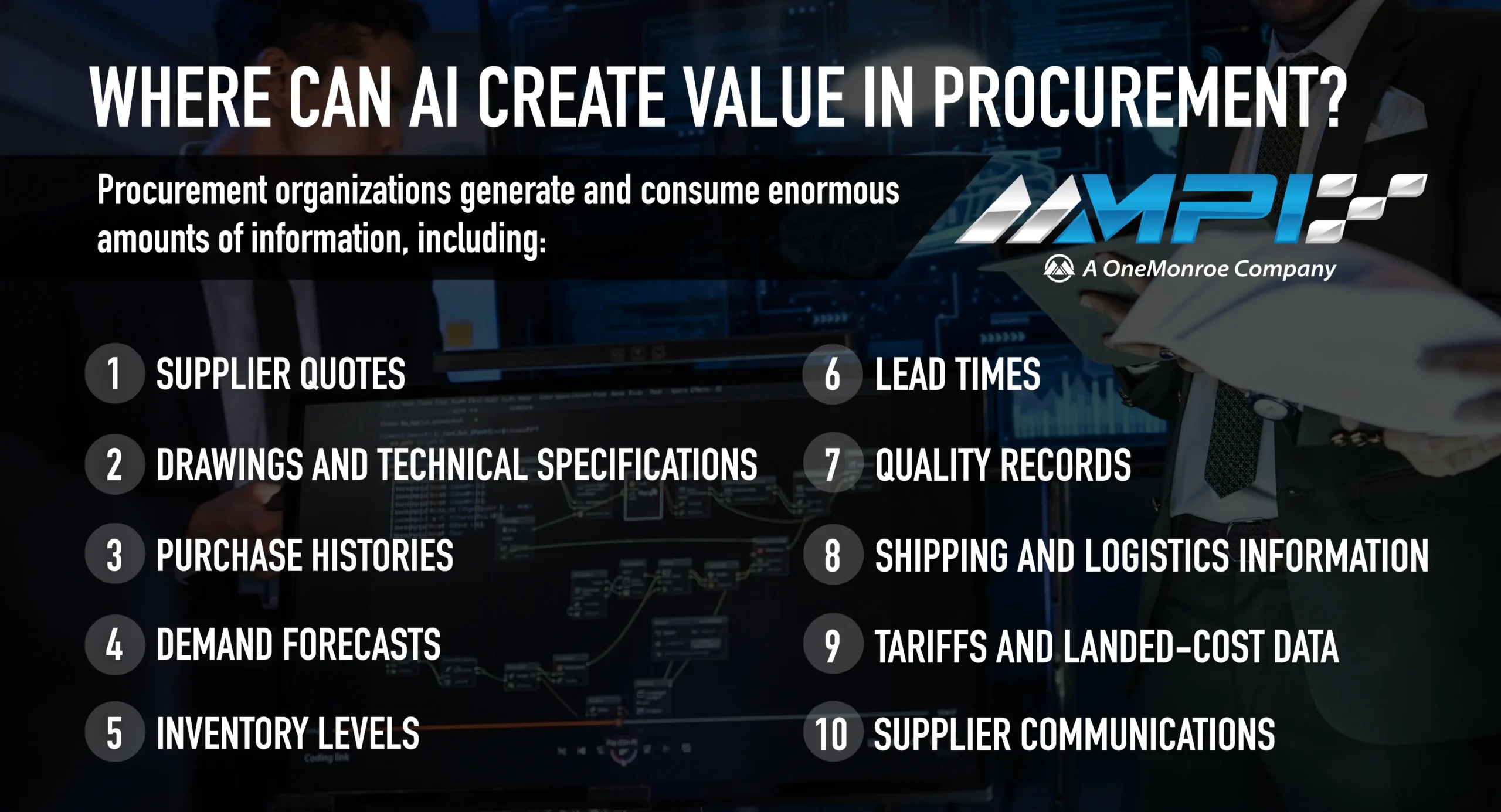
Procurement organizations generate and consume enormous amounts of information.
Supplier quotes, drawings, specifications, purchase histories, forecasts, lead times, quality records, inventory levels, shipping information, tariffs, supplier communications, and production requirements all contribute to sourcing decisions.
The challenge is connecting those data points quickly enough to make better decisions.
Several procurement applications are particularly promising.
Supplier Evaluation
Selecting a supplier requires buyers to compare more than price. Capability, quality history, capacity, lead time, geography, certifications, previous performance, tooling requirements, and commercial terms can all influence the decision. AI can help organize and analyze supplier information so procurement teams can identify relevant differences faster.
For example, a sourcing team reviewing multiple suppliers could use AI-supported analysis to flag unusual lead times, inconsistent commercial terms, missing information, or historical performance issues that deserve closer examination. That does not make the supplier decision. It helps the buyer know where to look.
RFQ Analysis
Complex RFQs can require procurement teams to compare quotes with different assumptions.
One supplier may include tooling while another quotes it separately. Freight terms may differ. Minimum order quantities, material assumptions, lead times, payment terms, or secondary operations may not be presented consistently. AI can help structure this information and highlight differences. That can reduce administrative work and give sourcing professionals more time to evaluate the issues that actually require manufacturing and commercial judgment.
For OEMs sourcing hundreds or thousands of custom components, the productivity opportunity can become significant.
Demand Forecasting and Inventory Optimization
Forecasting is another area where AI can support procurement.
Traditional forecasts often rely heavily on historical usage and customer projections. AI-based systems can potentially incorporate more variables, recognize patterns, and update expectations as new information arrives.
Better forecasting can support better purchasing decisions.
If demand changes can be identified earlier, procurement teams may be able to adjust orders, safety stock, replenishment timing, and supplier schedules before inventory becomes excessive or a shortage develops.
This is particularly relevant for global supply chains where production and transportation lead times can extend for weeks or months.
MPI already works with OEM customers on inventory requirements, forecasting, and just-in-time inventory management. AI does not change the underlying objective. It potentially provides another tool for improving the information used to make those decisions.
Quality Analysis
Supplier quality generates large amounts of potentially useful data.
Inspection reports, dimensional results, nonconformance records, corrective actions, returns, and supplier performance history can reveal patterns that are difficult to spot manually.
AI-supported analysis may help manufacturers identify recurring problems across parts, suppliers, materials, or manufacturing processes.
For example, a system might identify that defects become more frequent with a particular process, supplier, specification, or production condition.
That information still needs to be interpreted by quality and engineering professionals.
But finding the pattern faster can help teams investigate the right problem sooner.
Drawing and Document Analysis
Industrial sourcing is document-heavy. Drawings, specifications, bills of material, quality documents, certifications, and supplier records all contain information needed to source a component correctly. AI tools can help extract and organize information from these documents.
A procurement team could potentially use AI to identify materials, tolerances, processes, quantities, inspection requirements, or other details before beginning supplier evaluation. The benefit is speed. The risk is assuming that automated extraction is always correct. Engineering drawings can contain complex requirements, revision histories, notes, references, and tolerances where a small interpretation error can have major consequences.
AI can accelerate document review, but qualified people still need to verify critical requirements.
Supplier Risk Detection
Supplier risk rarely appears in one convenient data point.
Longer lead times, declining delivery performance, repeated quality issues, changing freight costs, geographic concentration, tariff exposure, and unusual purchasing patterns may each indicate developing problems. AI can potentially monitor multiple indicators simultaneously and identify changes that deserve attention. This is particularly valuable when procurement teams manage large supplier networks. The objective is not to predict every disruption. It is to give people earlier warning that a supplier, component, or sourcing region may require closer review.
Predictive Lead Times
A purchase order may say six weeks, but experienced buyers know actual lead time can behave differently. Supplier workload, raw-material availability, manufacturing capacity, transportation conditions, seasonality, and historical performance can all affect delivery. AI-based analysis could use actual supplier performance to develop more realistic lead-time expectations. That information could improve purchasing schedules, inventory targets, and customer commitments.
For global sourcing programs, even modest improvements in lead-time visibility can have meaningful effects on inventory planning.
AI Should Support Supplier Relationships, Not Replace Them
There is a limit to what procurement technology can understand from data alone. A supplier may be experiencing a temporary capacity problem but have an excellent plan to resolve it. An inexpensive quote may come from a manufacturer that does not fully understand the drawing. A higher-priced supplier may have a manufacturing process that significantly reduces long-term quality risk.
Experienced sourcing professionals learn these differences through supplier relationships, factory visits, engineering discussions, audits, negotiations, and years of manufacturing knowledge.
That context matters. Mechanical Power’s sourcing model, for example, is built around finding, vetting, validating, and working with manufacturing partners while acting as an extension of customers’ sourcing, procurement, engineering, supply-chain, and quality teams.
AI can make more information available to those people. It cannot replace the need to understand how a component is actually manufactured or whether a supplier can reliably produce it.
Build a More Predictable Global Sourcing Strategy
The lowest quote does not always create the lowest cost.
Start With the Procurement Problem, Not the AI Tool
- The strongest message coming from industrial AI is also one procurement teams can use.
- Do not start with AI and look for somewhere to deploy it.
- Start with an expensive or time-consuming business problem.
- Where are buyers spending excessive time comparing information?
- Where are inventory decisions consistently difficult?
- Where do supplier risks become visible too late?
- Where are quality teams manually analyzing large amounts of inspection data?
- Where are RFQs slowed by document review?
Once the problem is clear, manufacturers can evaluate whether AI offers a practical improvement and determine how that improvement will be measured.
Useful metrics could include sourcing cycle time, inventory levels, forecast accuracy, supplier delivery performance, quality costs, administrative hours, or RFQ turnaround time.
That moves the conversation from “Are we using AI?” to “Is AI improving the sourcing process?”
Better Technology Still Needs Better Sourcing Fundamentals
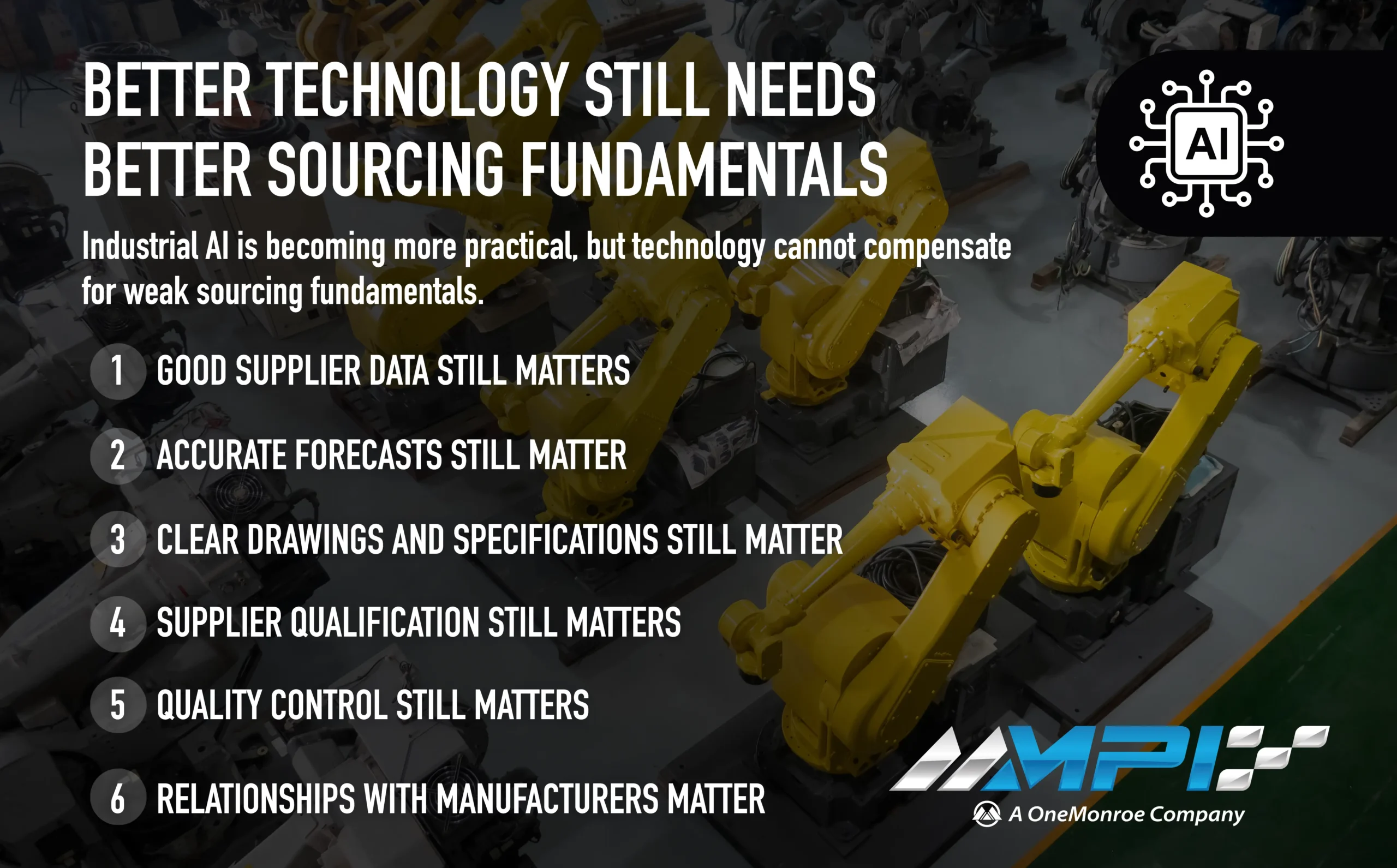
Industrial AI is becoming more practical, but technology cannot compensate for weak sourcing fundamentals.
- Good supplier data still matters.
- Accurate forecasts still matter.
- Clear drawings and specifications still matter.
- Supplier qualification still matters.
- Quality control still matters.
- And relationships with capable manufacturers still matter.
For procurement teams, AI’s biggest opportunity may be helping experienced people use all of that information more effectively.
MPI works with OEMs to identify, qualify, and manage manufacturing sources across domestic and global markets. As procurement technology improves, the objective remains the same: finding capable suppliers and building a supply chain that delivers the required quality, cost, inventory performance, and reliability.
Industrial AI Is Moving Toward Measurable Results
The significance of industrial AI at IMTS 2026 was not simply that more AI products were on display. It was the emphasis on implementation and measurable manufacturing impact. Procurement teams should apply the same standard.
AI can potentially improve supplier evaluation, forecasting, inventory planning, RFQ analysis, quality analysis, document review, risk detection, and lead-time prediction. But the technology earns its place when those capabilities produce better sourcing outcomes. The future of procurement is unlikely to be AI replacing sourcing professionals. It is more likely to be sourcing professionals using better tools to evaluate more information, identify problems sooner, and make better decisions.
Better sourcing decisions still depend on the right suppliers, the right information, and the right manufacturing expertise.
Talk with Mechanical Power about your component sourcing and supplier-network requirements. MPI can help evaluate domestic and global manufacturing options, qualify capable suppliers, and develop sourcing strategies built around quality, cost, delivery, and supply continuity.

Frequently Asked Questions
How can AI be used in manufacturing procurement?
Can AI select manufacturing suppliers automatically?
Can AI improve supply-chain forecasting?
Will AI replace procurement professionals?

Mechanical Power, Inc.