
Here’s what we’ll cover:
The 5 most common chain drive misapplications
Misapplication 1: Wrong chain pitch or type for the application
Misapplication 2: Inadequate or incorrect lubrication
Misapplication 3: Misalignment between sprockets
Misapplication 4: Incorrect tension — too tight or too loose
Misapplication 5: Operating beyond the chain’s rated capacity
Quick-reference: misapplication symptoms and fixes
Frequently asked questions
The 5 most common chain drive misapplications
Chain drive misapplications fall into five categories. Any one of them can cause accelerated wear, noise, elongation, or sudden failure. In practice, more than one is often present at the same time, which compounds the damage rate.
Wrong chain pitch or type for the application
Inadequate or incorrect lubrication
Misalignment between sprockets
Incorrect tension — too tight or too loose
Operating beyond the chain’s rated capacity
Each misapplication has a distinct failure signature. Understanding that signature lets you identify whether you have a selection problem, an installation problem, or an operating condition problem — before you order a replacement.
Misapplication 1: Wrong chain pitch or type for the application
Pitch is the distance between chain pin centers. It must match the sprocket exactly. Using a chain with the wrong pitch causes the rollers to seat incorrectly on the sprocket teeth, creating uneven load distribution and accelerated wear on both the chain and the sprocket.
Beyond pitch, chain type must match the operating conditions. A standard roller chain running in a washdown environment corrodes quickly. A chain rated for light conveying duty will fail rapidly under high-cycle drive loads. Engineering-class chains, heavy-series chains, and stainless or nickel-plated chains each exist for a reason.
What to check:
Confirm chain pitch matches the sprocket tooth pitch before installation.
Match chain series (standard, heavy, double-pitch) to the load and speed requirements.
Specify chain material based on the environment — corrosion, temperature, and contamination all affect chain type selection.
Did You Know?
MPI stocks roller chains, engineering-class chains, heavy-series chains, stainless, and specialty configurations. If you are specifying a replacement chain, bring the existing chain’s pitch, width, and part number when you contact us.
Maximize efficiency of your equipment.
Misapplication 2: Inadequate or incorrect lubrication
Lubrication failure is the single most common cause of premature chain wear. The lubricant’s job is to reduce metal-to-metal contact between the pin and bushing as the chain articulates around the sprocket. Without it, the bushing wears rapidly and the chain elongates — a condition often mistakenly called “chain stretch.”
Incorrect lubricant is as damaging as no lubricant. Heavy grease that cannot penetrate the pin-bushing interface provides little protection. Lightweight oils in high-temperature environments burn off quickly. Contaminated lubricant acts as a lapping compound, accelerating wear.
What to check:
Use manufacturer-recommended lubricant viscosity for the operating temperature range.
Apply lubricant to the inside of the chain loop where it contacts the sprocket — not the outer plates.
Establish a lubrication interval based on operating speed and environment, not on a fixed calendar schedule.
In contaminated or washdown environments, consider a sealed or self-lubricating chain to eliminate the maintenance variable entirely.
Misapplication 3: Misalignment between sprockets
Sprocket misalignment causes the chain to run at an angle across the sprocket face. This loads one side of the link plates disproportionately, causes lateral wear on the sprocket teeth, and generates noise and vibration. In severe cases, the chain rides off the sprocket.
There are two types of misalignment:
Parallel misalignment — the shaft centerlines are parallel but the sprockets are not in the same plane. Corrected by adjusting the axial position of one sprocket.
Angular misalignment — the shaft centerlines are not parallel. Requires shimming the bearing housing or realigning the shaft.
What to check:
Use a straightedge or laser alignment tool across the sprocket faces to confirm they are in the same plane.
Check alignment after any bearing replacement or shaft removal — reassembly rarely returns to the original position without verification.
Re-check alignment after the first 50 hours of operation on a new installation, as components settle.
Misapplication 4: Incorrect tension — too tight or too loose
Chain tension is one of the most frequently misjudged installation parameters. Both extremes cause damage, but in different ways.
Over-tensioned chain places continuous high load on the chain pins, bushings, and shaft bearings. It generates heat, accelerates wear at the pin-bushing interface, and can cause fatigue failure in the side plates. The drive also consumes more power than necessary.
Under-tensioned chain sags, causing it to slap against guards or jump teeth on the sprocket under load. This creates impact loads that the chain was not designed to absorb, leading to link plate cracking and sudden failure.
Correct chain sag for a horizontal drive is typically 2% to 3% of the center distance between shafts. On drives with center distances under 20 inches, sag should be minimal — the chain should feel firm with only slight deflection under moderate hand pressure.
What to check:
Measure center distance and calculate the allowable sag range before tensioning.
Inspect tension after the first few hours of operation — new chain seats into the sprocket teeth and will require re-tensioning.
Use an adjustable idler or take-up unit on long-center drives to maintain tension as the chain wears.
Misapplication 5: Operating beyond the chain’s rated capacity
Every chain has a published breaking load and a working load limit — typically 1/6 to 1/10 of the breaking load depending on application type. Operating above the working load limit causes fatigue failure in the link plates, which can occur suddenly and without visible prior wear.
Shock loading is the most common cause of exceeding rated capacity without knowing it. A chain running under normal average load may experience peak loads three to five times higher during start-up, reversal, or jam events. Standard chain ratings do not account for shock unless the chain is specifically rated for it.
What to check:
Calculate the design load using the actual transmitted horsepower, speed, and a service factor that accounts for shock, start-stop frequency, and hours per day of operation.
Select a chain with a working load limit at least 20% above the design load after applying service factors.
For high-shock applications, specify heavy-series chain or an engineering-class chain with higher fatigue resistance.
If failure is recurring on a correctly specified chain, investigate whether peak loads have increased due to changes in the driven equipment.
Source chain drives and sprockets through MPI
MPI has supplied power transmission chains and sprockets to OEMs and industrial operations for over 40 years. Whether you are replacing a failed chain, upgrading to a heavier series, or specifying a chain for a new application, MPI’s team can help you select the right chain and get it sourced quickly.

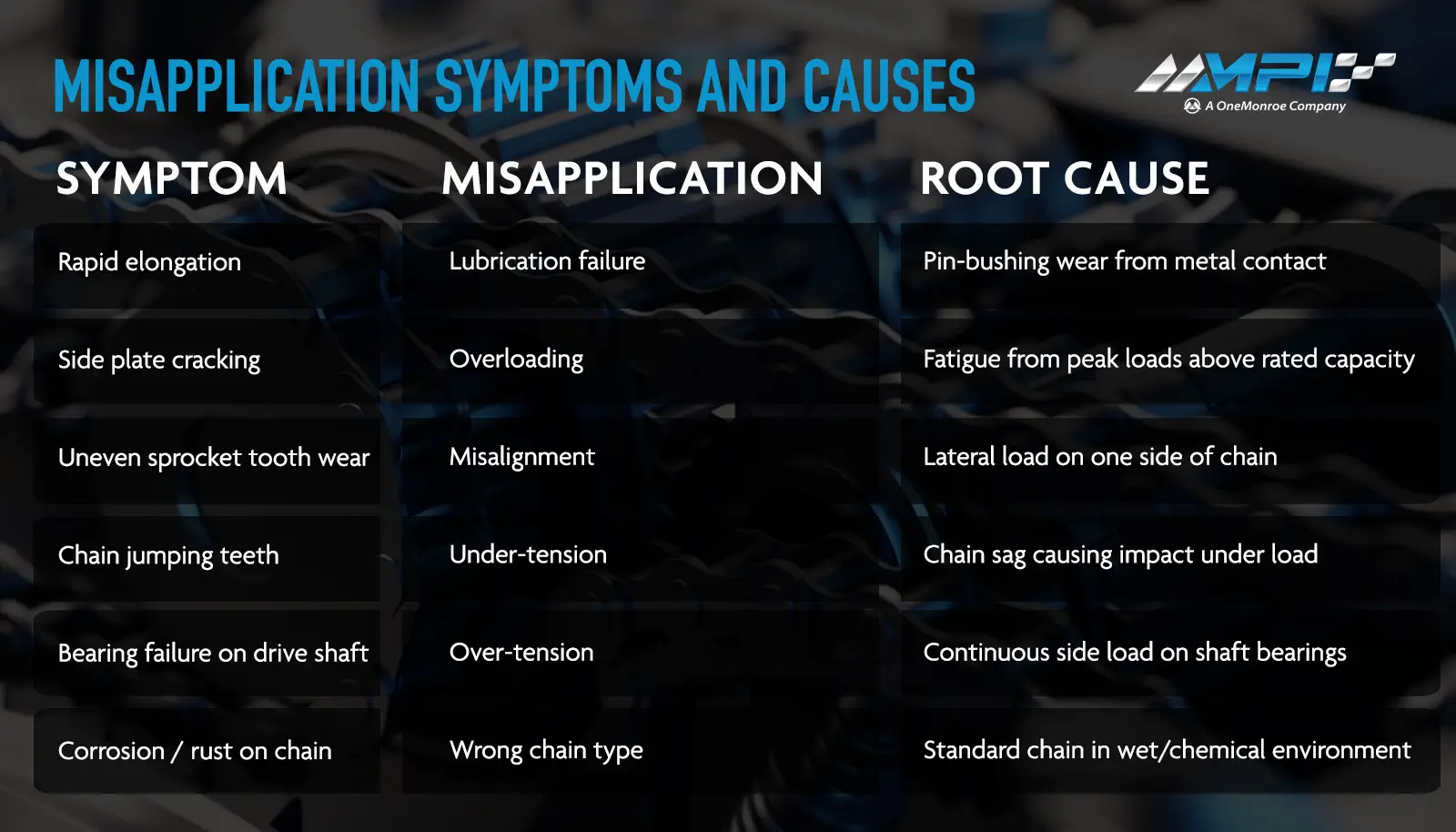
Quick-reference: misapplication symptoms and fixes
Frequently asked questions
What is the most common cause of chain drive failure?
Lubrication failure is the most frequent cause. When the lubricant between the pin and bushing breaks down or is absent, metal-to-metal contact causes rapid wear, chain elongation, and eventual failure. Correct lubricant type and consistent application intervals prevent the majority of chain failures.
How do I know if my chain drive is misaligned?
Visible signs include uneven wear on one side of the link plates, lateral marks on the sprocket teeth, chain noise or vibration at speed, and the chain riding to one side of the sprocket face. Confirm alignment using a straightedge laid across the faces of both sprockets — they should be in the same plane with no gap at either end.
How much sag should a chain drive have?
For a horizontal drive, correct sag is approximately 2% to 3% of the center distance between shaft centerlines. On a 40-inch center distance, that is 0.8 to 1.2 inches of total deflection measured at the mid-span of the slack side. Vertical and near-vertical drives require less sag.
Can I use a heavier chain series to fix a recurring failure?
Sometimes, but not always. If the chain is failing due to overloading, a heavier series chain with a higher working load limit may solve the problem. If the failure is caused by misalignment, wrong lubrication, or incorrect tension, upgrading the chain series will delay the failure but not prevent it. Identify the root cause before specifying a replacement.
How do sourcing companies help improve supply chain resilience?
Through supplier diversification, domestic and offshore hybrid sourcing, inventory programs, and long-term procurement partnerships.
What chain types does MPI supply for demanding environments?
MPI supplies standard roller chain, heavy-series roller chain, engineering-class chain, stainless steel chain, nickel-plated chain, and specialty chains for high-temperature, corrosive, and washdown environments. MPI also supplies matched sprockets. Contact MPI with your application details for a sourcing recommendation.

Daniel Szwed – Marketing Manager
Mechanical Power, Inc.